
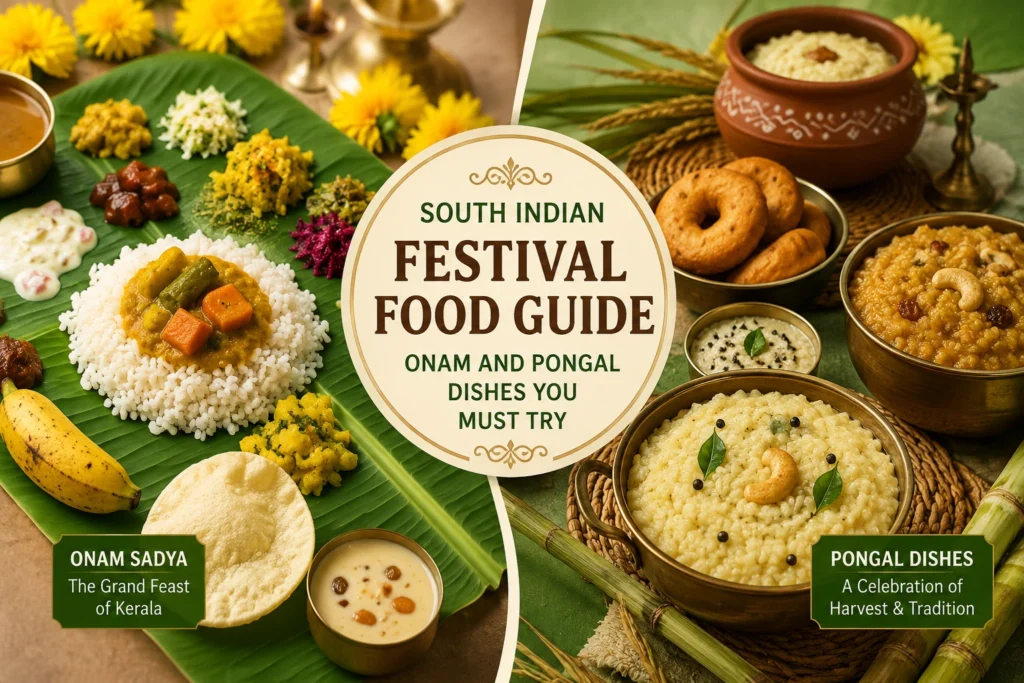
South India marks its two biggest harvest festivals with food at the centre of the celebration. Onam belongs to Kerala. Pongal belongs to Tamil Nadu. Both trace back to agrarian gratitude, yet the dishes, the rituals, and the calendars behind them are distinct. This guide breaks down what each festival serves, why, and when to expect it in 2026.
What is Onam Sadya?
Onam Sadya is the multi-course vegetarian feast served on a banana leaf during Kerala’s ten-day Onam festival. The festival marks the mythical homecoming of King Mahabali, an Asura ruler believed to visit Kerala once a year, and the appearance of Vishnu’s Vamana avatar who sent him to the underworld, according to Drikpanchang’s Onam festival records.
Onam falls in the Malayalam month of Chingam, which runs roughly between August and September on the Gregorian calendar. The celebration begins on Atham day and builds for ten days until Thiruvonam, the festival’s main day.
Sadya means “banquet” in Malayalam. The meal is served on a fresh banana leaf, with the broad end placed to the diner’s right and the pointed end to the left, a placement rule that food historians tie to Kerala’s Ayurvedic dining traditions.
Which dishes make up a traditional Onam Sadya?
A typical Onam Sadya includes between 20 and 30 dishes, though home spreads can run as low as 12 and festive or wedding versions can exceed 30, per Kerala food writers documenting the tradition. Every item is strictly vegetarian.
Core dishes include:
- Kerala matta rice – the base of the meal, served with multiple curries
- Parippu – a lentil preparation eaten with rice and ghee
- Sambar – a lentil and vegetable curry
- Avial – mixed vegetables in coconut and curd
- Olan – ash gourd and coconut milk in a mild curry
- Kaalan – yoghurt and raw banana in a thick curry
- Thoran – vegetables stir-fried with grated coconut
- Erissery – pumpkin and lentils with roasted coconut
- Pachadi – a sweet-and-tangy yoghurt-based side
- Pickles and pappadam – for spice and crunch
- Payasam – a milk, jaggery, or coconut milk dessert, usually the final course
Dry and semi-dry items go on the top half of the leaf. Rice, sambar, and curries go on the bottom half, following a serving order that guests follow while eating.
When does Onam fall in 2026?
Onam 2026 runs from Atham on August 16 to Thiruvonam on August 26, a Wednesday, based on Drikpanchang’s Malayalam calendar calculations. Thiruvonam is the festival’s main day, when families gather for the full Sadya and offerings are made to Vishnu and King Mahabali.
The exact dates shift each year because Onam follows the Malayalam solar calendar rather than the Gregorian calendar. Families and restaurants planning Onam menus typically build up to Thiruvonam across the full ten-day period, not just the final date.
What is Pongal and why does it mark the harvest?
Pongal is a four-day Tamil harvest festival dedicated to Surya, the Sun God, thanking him and nature for a successful rice harvest. The festival opens the Tamil month of Thai and coincides with Makar Sankranti, observed across North India on the same astronomical event.
The name Pongal comes from the Tamil word for “to boil, overflow,” referring to the ceremonial dish of new-harvest rice boiled with milk and jaggery in a clay pot until it spills over, a moment marked by the call “Pongalo Pongal.”
The four days are Bhogi, Thai Pongal, Mattu Pongal, and Kaanum Pongal. Bhogi involves cleaning homes and burning old belongings in a bonfire. Thai Pongal is the main day. Mattu Pongal honours cattle for their role in farming. Kaanum Pongal closes the festival with family visits and outings.
Which dishes are served during Pongal?
Pongal’s food centres on freshly harvested rice, prepared sweet and savoury.
- Ven Pongal – a savoury dish of rice, moong dal, ghee, pepper, and cumin
- Sakkarai Pongal – the sweet version, made with jaggery, ghee, cashews, and raisins
- Medu Vada – crisp lentil fritters served on the side
- Sambar – a lentil and vegetable curry accompaniment
- Coconut chutney – ground coconut, chilli, and tempered spices
- Payasam – a sweet dessert served on festive occasions
The Pongal dish itself is cooked outdoors in a new clay pot as a ritual called “Pongal oothum,” with the overflow read as a sign of coming prosperity.
When does Pongal fall in 2026?
Pongal 2026 runs from Bhogi on January 14 to Kaanum Pongal on January 17. Thai Pongal, the festival’s central day, falls on January 14, with the Sankranti moment recorded at 3:13 PM, according to Drikpanchang’s Tamil Panchangam calculations.
Because Pongal follows the Tamil solar calendar and is tied to the sun’s entry into Capricorn, the dates shift by a day or two each year. Mattu Pongal and Kaanum Pongal follow on the two days after Thai Pongal.
Where can you taste an authentic Onam Sadya or Pongal spread in London?
Recreating a full Sadya or a proper clay-pot Pongal takes fresh coconut, curry leaves, jaggery, and hours of preparation that most home kitchens in the UK cannot manage on a weekday. Diaspora restaurants fill that gap by sourcing South Indian staples year-round rather than only during festival weeks.
Anandha Bhavan in Wembley serves South Indian vegetarian dishes drawn from both Kerala and Tamil Nadu traditions, including festive staples like sambar, avial, and payasam alongside everyday South Indian favourites. Check the current menu for festival-style thalis and individual dishes before planning a visit.
Final thoughts
Onam and Pongal both grew from South India’s agrarian calendar, yet each festival tells its story through a different plate. Onam’s Sadya is one grand, balanced feast eaten on a banana leaf. Pongal’s food is spread across four days built around a single clay pot of rice, milk, and jaggery. Understanding the dates, the dishes, and the meaning behind each helps any visitor to a South Indian table eat with more context, whether that table is in Kerala, Tamil Nadu, or a restaurant in London.
For a taste of both traditions without the festival-week prep, visit Anandha Bhavan in Wembley.